Billboard Chris
Spenden

Die Fakten · Branchendokumente

Branchendokumente

Weitere wichtige Dokumente, darunter die WPATH Files — durchgesickerte Dokumente und Videos von Fachleuten der „Trans-Gesundheit“.

Dokumente

Die WPATH Files, CMS, Wolves in White Coats, das finnische Register und ASPS

Die WPATH Files (World Professional Association for Transgender Health) sind durchgesickerte interne Akten. Die endgültige CMS-Regel vom August 2026 beendet die bundesweite Zahlung durch Medicaid und CHIP für geschlechtsablehnende Eingriffe an Kindern. Wolves in White Coats ist der HHS-Bericht über Versicherungscodes. Das finnische Register ist Ruuska et al. 2026 — fachpsychiatrische Versorgung nach Überweisung an einen „Gender-Dienst“. ASPS rät, „Gender-Chirurgie“ bis 19 aufzuschieben — fachliche Empfehlung.

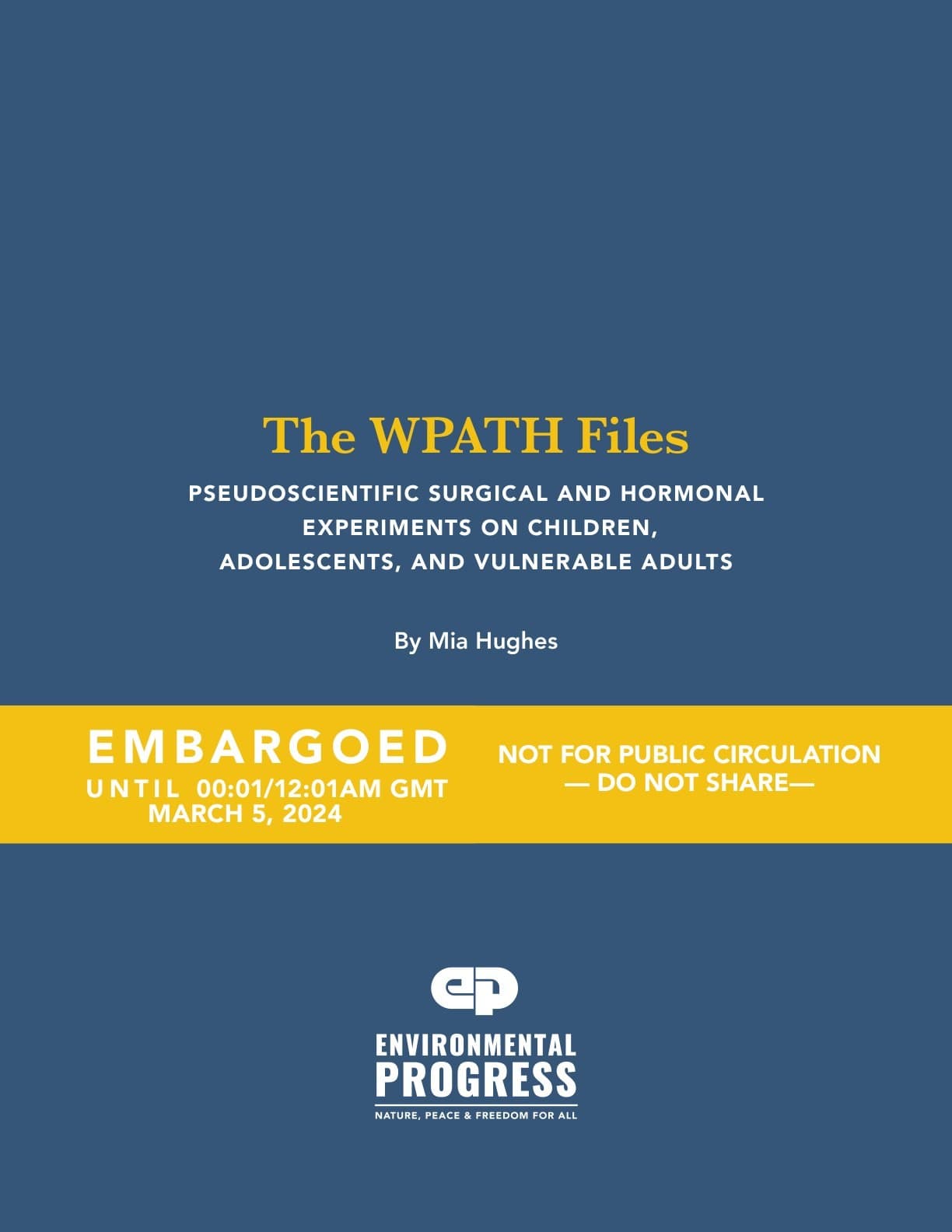
The WPATH Files cover

2024 · International

The WPATH Files: Pseudoscientific Surgical & Hormonal Experiments on Children

Studienziel

Files reveal discussions among clinicians that demonstrate serious issues about the ethical and scientific basis of their sex-rejecting procedures, highlighting issues with WPATH’s (World Professional Association for Transgender Health) Standards of Care (SOC) which has shaped global transgender healthcare policies.

Befunde

  • Lack of informed consent: clinicians acknowledging that some patients, including minors and those with severe mental health issues, are receiving irreversible treatments such as puberty blockers, hormones, and surgeries despite not being able to fully understand the consequences, such as infertility or loss of sexual function.
  • Awareness of harmful outcomes: WPATH members discuss serious side effects of treatments, including cancer, pelvic floor dysfunction, and sterility, yet often dismiss concerns about long-term patient outcomes, prioritizing access to interventions over caution.
  • Unscientific practices: The files reveal an improvisational approach to treatments, with clinicians discussing experimental procedures like “nullification” surgeries and acknowledging a lack of evidence for long-term outcomes, undermining WPATH’s claim of providing evidence-based care.

Editorial illustration of an HHS campus and a final-rule binder

2026 · United States

CMS Final Rule

Federal Medicaid and CHIP (Children’s Health Insurance Program) funding ended for sex-rejecting procedures on children

Befunde

  • The rule prohibits federal Medicaid dollars for sex-rejecting procedures for individuals under age 18, and federal Children’s Health Insurance Program (CHIP) dollars for individuals under age 19 (CMS-2451-F).
  • HHS says the final rule is scheduled to take effect October 13, 2026.
Editorial illustration of an empty white coat, wolf silhouette, and claim forms

2026 · United States

Wolves in White Coats

How Doctors and Hospitals Pushed and Profited from the Fraud of “Gender Medicine”

Befunde

  • HHS reports that more than 225 hospitals and health systems established pediatric gender programs nationwide.
  • Nationwide claims data from 2015 through 2025 identified approximately $50 million in insurance claims for puberty blockers billed using endocrine disorder diagnostic code E34.9 (Endocrine Disorder, Unspecified).
Editorial illustration for the Finnish register follow-up on specialist psychiatric care

2026 · Finland

Finland register — Ruuska et al. (Acta Paediatrica, 2026)

A Finnish nationwide register followed every under-23 referred to gender services from 1996–2019, for up to 25 years. Psychiatric care was already high before referral and stayed high after. After cross-sex hormones and surgeries, specialist psychiatric care went up, not down: 19% before the first clinic visit, 49% after the last procedure. The authors: psychiatric needs do not subside after medical gender reassignment.

Befunde

  • Nationwide register of all under-23s referred to specialised gender identity services, 1996–2019: 2,083 people vs 16,643 matched controls, followed for up to 25 years.
  • Specialist psychiatric care was already higher before referral (45.7% vs 15.0%) and still higher from two years after referral onward (61.7% vs 14.6%).
  • Among those who received cross-sex hormones or surgery, the share needing specialist psychiatric care, before the first clinic visit vs any time from two years after it: males 9.8% to 60.7%, females 21.6% to 54.5% (both sexes: 19.2% to about 56%).
  • New analysis (September 2026), counted only from each person’s last step (cross-sex hormones, chest surgery, or genital surgery): 19.2% had needed specialist psychiatric care before the first clinic visit, 48.9% after the last procedure. Matched peers: 14.4% to 13.2%. About six times as likely as the general population to need specialist psychiatric care after their last procedure, for both males and females. Same group and same starting point; the count starts later, so it covers less time.
  • Nearly 50 researchers and clinicians signed a letter of concern. The authors re-ran the numbers twice, five or more years out and after the last procedure, and stood by their findings.
  • The authors: psychiatric needs do not subside after medical gender reassignment.

2026 · United States

American Society of Plastic Surgeons — Gender Surgery for Children and Adolescents (Feb 3, 2026)

ASPS advises surgeons to delay breast/chest, genital, and facial gender surgery until patients are at least 19. Cites insufficient evidence of a favorable risk–benefit ratio, low-certainty mental-health evidence, concerns about long-term harms, and irreversibility in a developmentally vulnerable population. Professional guidance.

Befunde

  • ASPS advises delaying breast/chest, genital, and facial gender surgery until patients are at least 19.
  • The statement cites insufficient evidence of a favorable risk–benefit ratio and low-certainty mental-health evidence.
  • It notes concerns about long-term harms and irreversibility in a developmentally vulnerable population.
  • This is professional guidance.

Abonnieren. Updates erhalten.

Nachrichten, juristische Siege und Werkzeuge, die Wahrheit zu sagen — ein Gespräch nach dem anderen.

Wählen Sie ein tägliches Update, einen Wochenrückblick oder beides.

E-Mail-Häufigkeit

Eins oder beides auswählen.