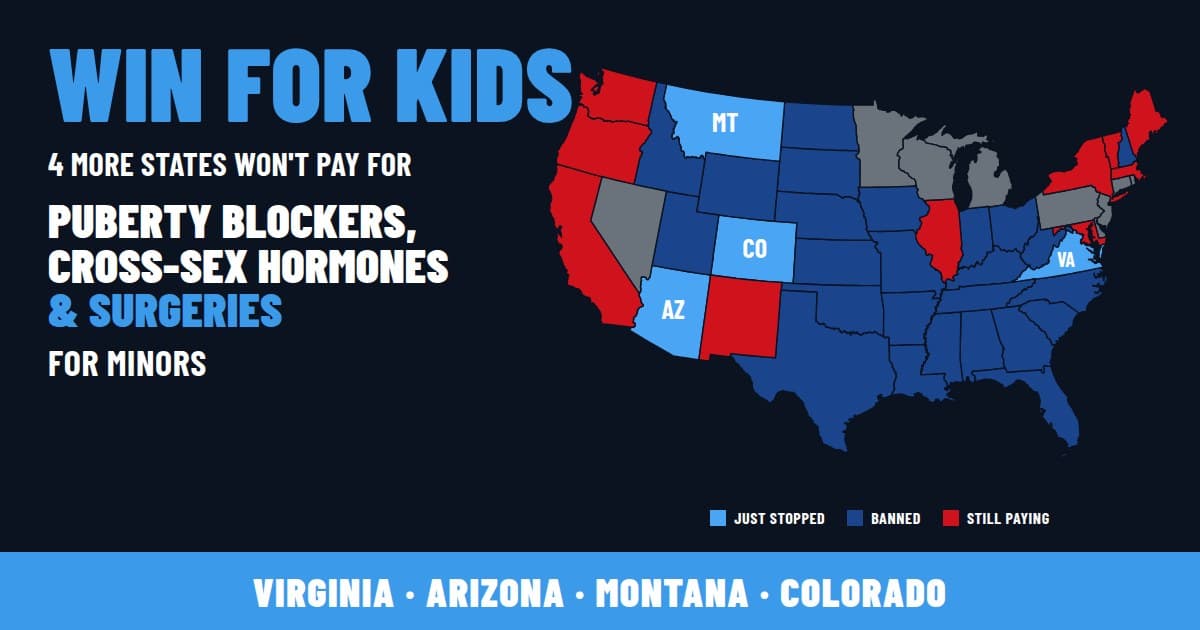
Good news for kids. When federal Medicaid money for puberty blockers and cross-sex hormones ended today, four more states chose to stop paying rather than make their taxpayers cover the cost.
The states that stopped
- Virginia: As of today, Medicaid no longer pays for these drugs or surgery for members under 18, or CHIP members under 19. Children already on cross-sex hormones get up to six months of federally funded tapering, and that's all. (Virginia DMAS)
- Arizona: AHCCCS's pharmacy rules now say puberty blockers and cross-sex hormones "when used for gender dysphoria in patients less than 19 years of age are no longer covered under Medicaid and will be denied as benefit exclusion." Anyone who started on or before Oct 13 is grandfathered for six months. Arizona Medicaid has excluded sex-change surgery since 1982. (AHCCCS pharmacy prior authorization criteria)
- Montana: DPHHS stopped paying for puberty blockers, cross-sex hormones and surgery for Medicaid members under 18 and CHIP members under 19. Children already on cross-sex hormones can taper off through April 13, 2027. (Montana DPHHS) Why was Montana paying at all? Lawmakers passed SB 99 in 2023 to ban these procedures for minors and bar public money for them, but a Missoula judge blocked it, and the Montana Supreme Court kept that block in place in December 2024. So Montana Medicaid kept paying until Washington cut off the money. (Montana Free Press, Montana Supreme Court ruling)
- Colorado: Coverage is suspended. The state says it has no authority to pay without federal money unless lawmakers vote for it, and they don't return until January. Colorado Medicaid spent just under $1.3 million on these services for under-19s in 2024–25, and $7.1 million from 2019 to 2025. (Colorado Sun)
Virginia, Arizona and Colorado all have Democratic governors, yet none of them chose to keep the money flowing. Virginia and Colorado are even plaintiffs in the lawsuit to overturn the rule, and they still stopped paying. (complaint)
The states that never paid
About 27 states ban these procedures for minors, so their Medicaid programs never paid for them in the first place. With today's four, that's roughly 30 states where Medicaid won't pay to block a child's puberty.
The federal rule
The CMS rule CMS-2451-F, in effect from today, bars federal Medicaid money for puberty blockers, cross-sex hormones and surgery on anyone under 18, and federal CHIP money for anyone under 19. The six-month taper covers only children already on cross-sex hormones. Puberty blockers and surgery get no grace period. Counselling stays fully covered. (Federal Register)
The holdouts: 10 states putting it on your tab
Not every state got the message. These ten will use state taxpayer money to keep paying:
- California: Medi-Cal stops paying, but a new state-only grant program run by HCAI, a separate state agency, picks up the bill for minors on Medi-Cal and CHIP, surgery included. The state admits the money isn't ready on day one and has published no price tag. (HCAI, Medi-Cal Rx notice)
- Oregon: About 600 Oregon Health Plan members under 18 keep their coverage. The state pays for their drugs and surgeries directly through its fee-for-service program (Oregon Capital Chronicle) and plans to ask lawmakers for more money next year. (Oregon Health Authority)
- Washington: In an Oct 8 notice, the Health Care Authority said the rule covers "certain surgical and hormonal interventions" and that it "will continue to cover these services using state-only (non-Medicaid) funds." (HCA notice)
- New York: Oct 2 guidance covers puberty blockers, cross-sex hormones and surgery, and tells doctors to keep providing these services "as normal," paid for "by state-only funding." (NY Department of Health)
- Massachusetts: The money comes from the state's $8.5 million Affirming Health Care Trust. About 550 MassHealth members aged 18 and under were on hormones or puberty blockers last year. The state hasn't said what this will cost each year. (GBH)
- Maryland: An Oct 2 notice says Medicaid "will continue to fund" these services for minors "using state dollars," as Maryland's 2023 Trans Health Equity Act requires. (Maryland Medicaid)
- Illinois: HFS will pay with state-only money through June 30, 2027, the end of the state's budget year, and leave anything after that to the next budget. (Summary of HFS provider notice, via Illinois Health and Hospital Association)
- Maine: An Oct 9 bulletin says state law requires MaineCare to keep covering minors, so doctors now tag the claims to be paid "using state-only funds." (Maine DHHS)
- Vermont: The rule DVHA describes covers "hormone treatments and surgical procedures." On Sept 25 the state said "nothing is changing" for Medicaid members under 18, with Vermont "stepping in with state funds where federal funding ends." (Vermont DVHA)
- New Mexico: Puberty blockers and cross-sex hormones for Medicaid members aged 12 to 17 "will continue to be covered with state funds," with prior approval required. The state doesn't cover surgery for minors. (NM Health Care Authority, Oct 9)
Not yet announced
In these 10 places, the federal Medicaid money stopped on Oct 13. Each now has to choose: put state taxpayers on the hook, or end coverage like Virginia, Arizona, Montana and Colorado. None has said which yet.
- Michigan: A Sept 9 notice to tribes says the change "will result in a reduction of covered services" from Oct 13. The state still hasn't said whether it will use state money. (MDHHS L 26-53)
- Delaware: Its health department says it "must comply" with the federal rule, which only means federal money stops. It will notify the families and providers affected but hasn't said whether state money will pick up the bill. (Delaware DHSS)
- Connecticut: A lead plaintiff in the lawsuit against the rule, but it hasn't said whether it will use state money. (CT News Junkie)
- Minnesota: Suing to overturn the rule, but hasn't said whether it will use state money in the meantime. (CT News Junkie)
- New Jersey: Suing to overturn the rule, but hasn't said whether it will use state money in the meantime. (CT News Junkie)
- Pennsylvania: Gov. Shapiro joined the lawsuit, but the state hasn't said whether it will use state money. (CT News Junkie)
- D.C.: Suing to overturn the rule, but hasn't said whether it will use local money in the meantime. (CT News Junkie)
- Hawaii: Suing to overturn the rule, but hasn't said whether it will use state money in the meantime. (CT News Junkie)
- Nevada: Suing to overturn the rule, but hasn't said whether it will use state money in the meantime. (CT News Junkie)
- Rhode Island: Suing to overturn the rule, but hasn't said whether it will use state money in the meantime. (CT News Junkie)
What it costs
CMS estimates the rule cuts Medicaid and CHIP spending by $235 million from 2027 through 2036: $138 million federal and $97 million state. States that hadn't restricted these procedures accounted for 76% of the spending. In the states listed above, the federal share now falls on state taxpayers. (AJMC summary of the CMS analysis)
The bottom line
Today about 30 states are out of the business of paying to block children's puberty. Virginia, Arizona, Montana and Colorado just proved it doesn't take a red state to do it. Ten states are still sending you the bill. If you live in one of them, ask your legislators why.