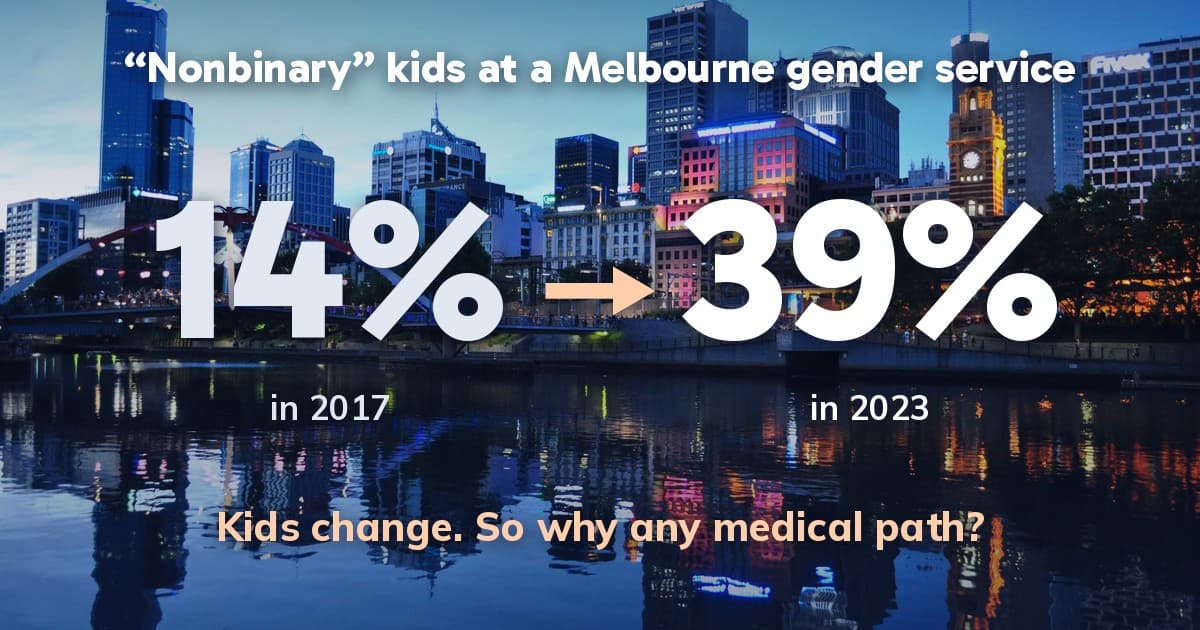
In 2017, 14.2% of young people coming to a specialist youth gender service in Melbourne said they were "nonbinary." By 2023, it was 39%.
That's from two new studies by Melbourne's Murdoch Children's Research Institute (MCRI). Together they show something every parent already knows: kids change.
14.2% to 39%
The JAMA Pediatrics study, led by Pip Buckingham, looked at young people starting at a specialist pediatric gender service. According to MCRI, the share who call themselves "nonbinary" rose from 14.2% in 2017 to 39% in 2023.
They reported less body dissatisfaction than other patients. Yet almost all still wanted to change at least one body part, most often their breasts or chest, or their voice. The researchers' takeaway: more "person-centered" care.
Goals that keep moving
The second study, in The Lancet Regional Health – Western Pacific, followed 234 children aged 8 to 17 from the same kind of clinic for up to two years. It tracked names, pronouns and appearance at home, at school, online, with friends and with extended family.
- 60.7% changed their "social transition" goals during the study
- younger children were more likely to add new goals over time, MCRI says
- the authors call social transition "a dynamic, non-linear process driven by evolving personal goals"
Their conclusion? Support should become more flexible, and policy should "move away from rigid definitions."
Kids change. Bodies don't change back
These researchers have documented that what kids say about themselves keeps changing within months and years, as do their goals, and that a fast-growing share say they are neither sex at all.
Yet those same children are asking to change their breasts, chests and voices. It's yet another strong reason not to put a child on puberty blockers, cross-sex hormones or surgery. One thing is certain: at 25, they'll still be the same sex they were born.
When the goals keep changing, the only safe medical path is no medical path.
- australia
- puberty blockers
- evidence
- children